Viagra for Psychological Erectile Dysfunction: Why the Pill Doesn't Fix the Problem
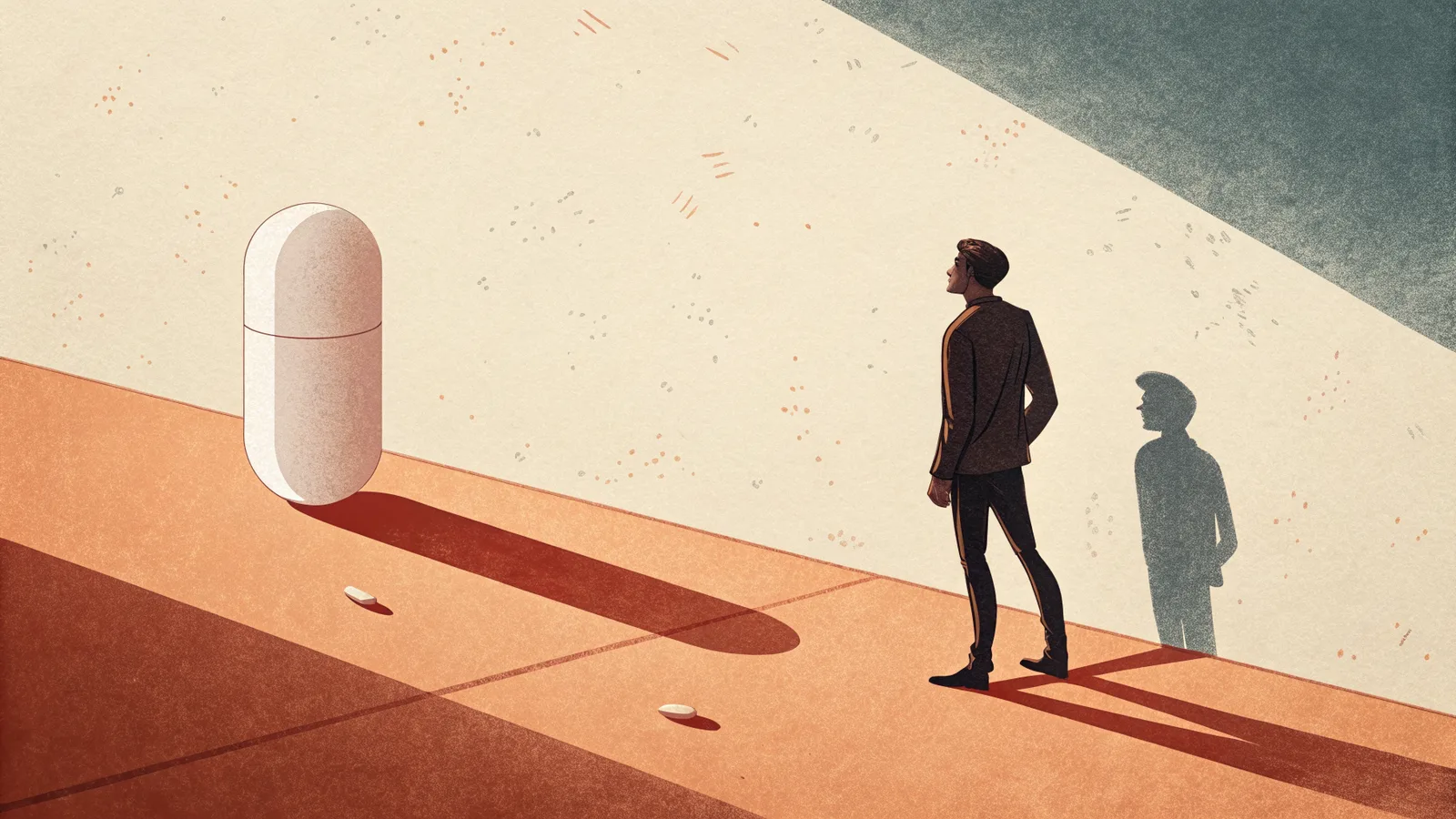
You took the pill, it worked, relief. And then, a few weeks later, right before you're about to have sex again, this thought: what if it doesn't work this time without it? What if I always need the pill? If you know this thought, you're not the only one, and it points to something important: the fear isn't gone. It's just moved to a new stage.
What PDE5 inhibitors like Viagra actually do
To understand why that's the case, it helps to look at the mechanism. An erection happens through a signal that travels from the brain through the spinal cord to the nerves in the penis. There, nitric oxide is released, which leads through several steps to a messenger called cGMP. That messenger makes blood flow into the erectile tissue and the veins close off so it stays there. PDE5 inhibitors like Viagra act right at that last step: they block the breakdown of cGMP and extend its effect (review).
That's a purely mechanical, vascular process. With a physically caused erectile dysfunction, say from circulation problems, that's a very direct lever, and in that case the pill is a legitimate, well studied medication. But look at the start of the chain again: the signal begins in the brain. And that's exactly where the pill doesn't act.
Where the real problem lies with a psychological cause
If your brain rates a situation as a threat, say because of performance pressure, fear of failure, or constantly watching to see if it'll work this time, the higher level signal gets blocked, regardless of how turned on you actually are. The problem then isn't a lack of blood flow. It's that your nervous system never rates the situation as safe enough to send the signal in the first place. A pill that acts at the end of the chain changes nothing about what happens at the start of it.
That's exactly why Viagra often helps even with purely psychologically caused problems, at least to some degree, partly through a placebo effect (study). You know the pill works, and just knowing that takes some of the pressure off, and with less pressure the blockage eases. That feels like a solution. It isn't, though, because the performance anxiety that actually caused the problem hasn't been addressed. It's only been covered up.
Why the fear can even grow with the pill
And here's the catch that makes this tricky. Once you get used to sex only working reliably with the pill, a new thought easily forms: it doesn't work without it. That's not your imagination, it's exactly how your nervous system learns. Every time you reach for the pill without even trying to go without it, you reinforce that link a little further. Support turns into a mental dependency, and the new fear that grows out of it can be bigger than the original one: no longer just worry about whether it'll work, but worry about whether it'll ever work again without help.
On top of that, there's a detail almost no one considers: you roughly know the window in which the pill works. Knowing that can itself become pressure, the thought that you have to perform within that window. You trade one test situation for another.
What actually matters instead
The problem is actually rarely the weaker or absent erection itself. The problem is how you rate it: as danger, as personal failure, or simply as something normal that happens sometimes. That evaluation decides how the situation feels and how your nervous system reacts next time, not the pill. The real lever with psychologically caused problems is in your head, not in your bloodstream.
That's not a signal to stop the pill right away. Quite the opposite: stopping abruptly isn't a good idea, and that decision always belongs in consultation with your doctor, along with the question of whether a physical cause or pre-existing condition is behind it in the first place. That needs medical clarification up front, before you even work out whether your problem is more physical or psychological. With an organic cause, the pill isn't a replacement for training, it's a sensible, legitimate medication you can keep taking in consultation with your doctor.
If the psychological side is the real reason for you, though, the first step isn't giving the pill up, it's a shift in perspective: recognizing that your body doesn't need the pill, even while you're currently taking it. What helps here is getting clear on when sex has worked without the pill before, because that experience is what builds new trust, not just knowing about it. Your own motive is worth an honest look too: are you taking the pill out of desire and curiosity, or as a safety net, because you're afraid of failing?
Short and honest
Performance anxiety isn't a state a pill dissolves. It's a learned pattern in your nervous system, and based on experience, rational understanding alone, simply knowing that the pill doesn't treat the cause, tends to change very little on its own. What changes it is mainly real, repeated experiences of safety and presence, not a medication that acts somewhere else entirely, and not just that knowledge by itself.
That takes time and structure, not a trick and not a single dose. Most men who stick with this path consistently notice a clear change after a few months; some faster, others closer to half a year. How fast it goes depends mostly on how regularly you practice, with the first small progress usually showing up earlier. And yes, that means real effort. It'll be frustrating at times. We'd love to promise you something else, but this is the only path that works long term.
That's exactly why we're building Bedfit: structured training that helps you address the actual cause, whether you're currently taking a pill or not. For anything about medication, dosage, or stopping, your doctor is still the right person to ask. We focus on the fear behind it.
Join the waitlist and be the first to know when we launch.